Key takeaways
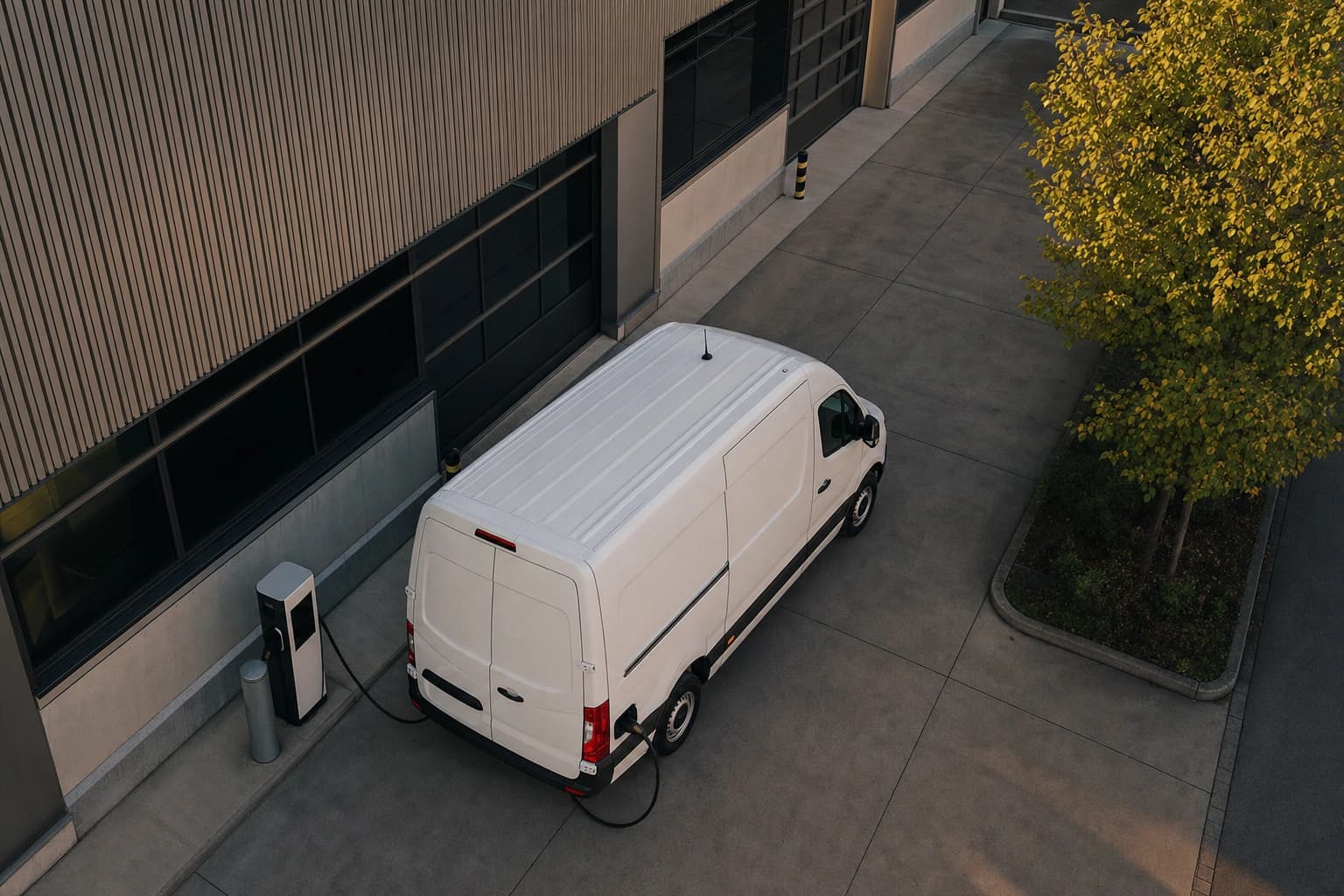
- For parking at the workplace and overnight, AC charging (Type 2) with 11–22 kW is sufficient; DC charging (fast charging) is sensible for short stops and logistics.
- The grid connection is the critical bottleneck: Intelligent load management is necessary to avoid exceeding the connection capacity and to save costs.
- Funding for the development of commercial charging infrastructure is coordinated, among others, by NOW GmbH, whereby lucrative locations are often bundled with less lucrative ones.
- Calibration duty (Eichrecht) applies as soon as charging power is sold or billed to third parties such as employees or customers, regardless of the charging power in kW.
- Since 1 January 2024, Section 14a EnWG applies: the grid operator may briefly throttle wallboxes above 4.2 kW to 4.2 kW during grid strain, in return grid fees drop either as a flat amount (€110–190/year) or a percentage.
Determining charging demand: Power and number of charging points
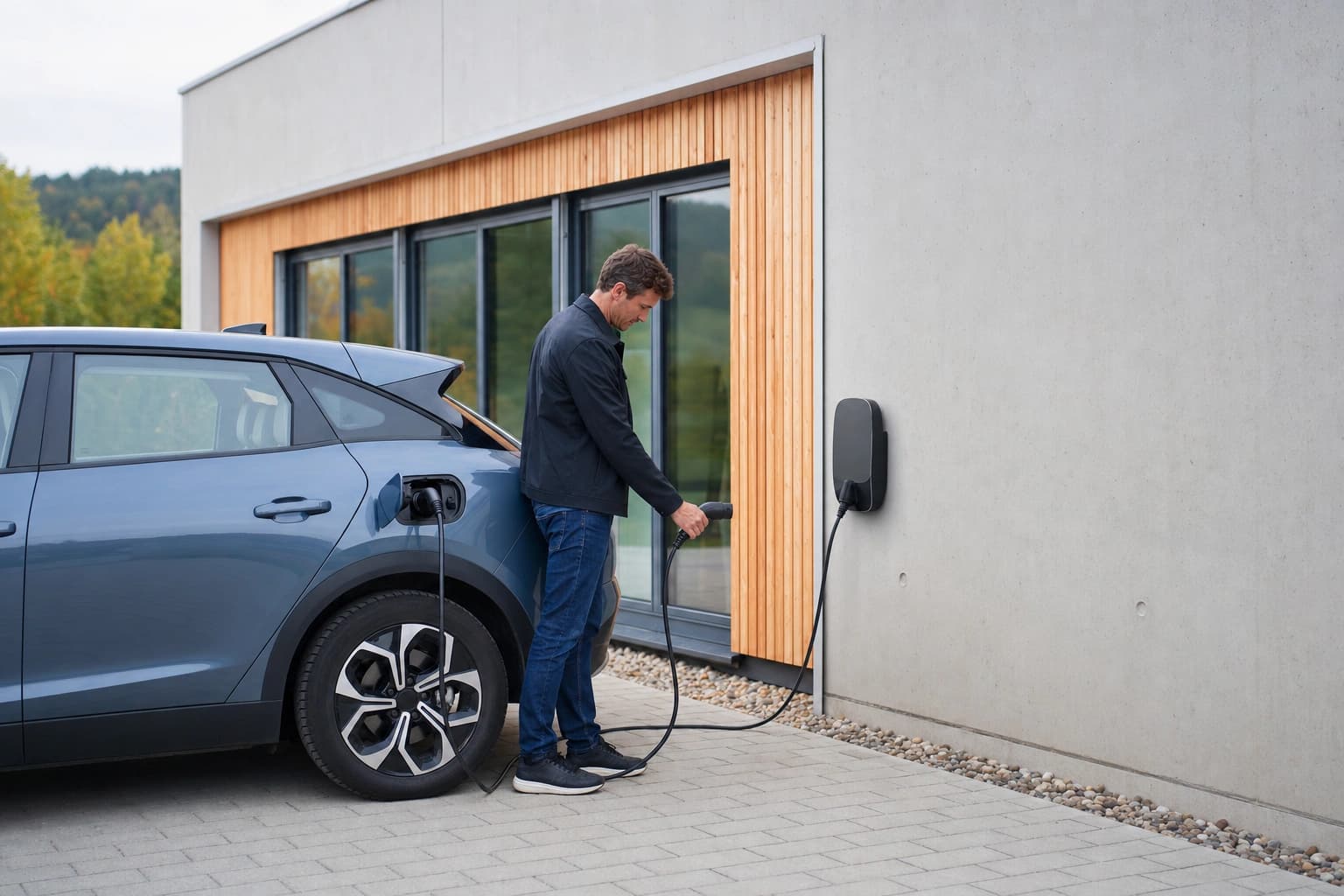
Planning commercial charging infrastructure begins with analysing the operational purpose. For daily commuter traffic and employee car parks, where vehicles are often parked for several hours, charging with alternating current (AC) is usually sufficient. According to Wikipedia, power outputs of 3.6 kW to 7.2 kW are permanently transmitted via Type 2 plugs for AC charging [Wikipedia]. For commercial use, however, more future-proof guideline values of 11 kW or 22 kW (three-phase) per charging point should be aimed for today, in order to fully charge company cars with larger batteries within a typical working time of 4–8 hours.
The number of charging points depends on the fleet size and the parking duration. A common guideline value for operations without reverse direction (feedback) is that about 20–30 % of parking spaces should be electrified, provided there are no fleet models covering all employees. For fleets with fixed deployment plans (e.g. logistics, care services), the charging power must be designed so that all vehicles are charged again by the start of the next deployment. Establishing depot charging makes sense here.
AC or DC charging: The right choice for the application
The decision between AC (alternating current) and DC (direct current) is decisive for costs and charging time. With AC charging, rectification takes place in the vehicle via the on-board charger. This is the standard solution for workplace charging and home, as the technology in the wallbox is more cost-effective. The standard established in the EU is the Type 2 plug [Wikipedia]. For everyday work, this type of charging is usually sufficient, as the vehicles are stationary for long periods anyway.
DC charging (fast charging) is aimed at applications where speed is key, such as in long-distance traffic or for logistics fleets with short dwell times. Here, the current is rectified in the column and fed into the vehicle with high power. CCS2 (Combined Charging System) and partly CHAdeMO have established themselves as standards [Wikipedia]. Fast charging points are significantly more expensive to purchase and operate, but charge with guideline values of 50 to 150+ kW in a significantly shorter time. For hotels or retail areas (Destination Charging), AC is usually sufficient; for service stations or parcel centres, DC is often mandatory.
Grid connection and load management: The critical bottleneck
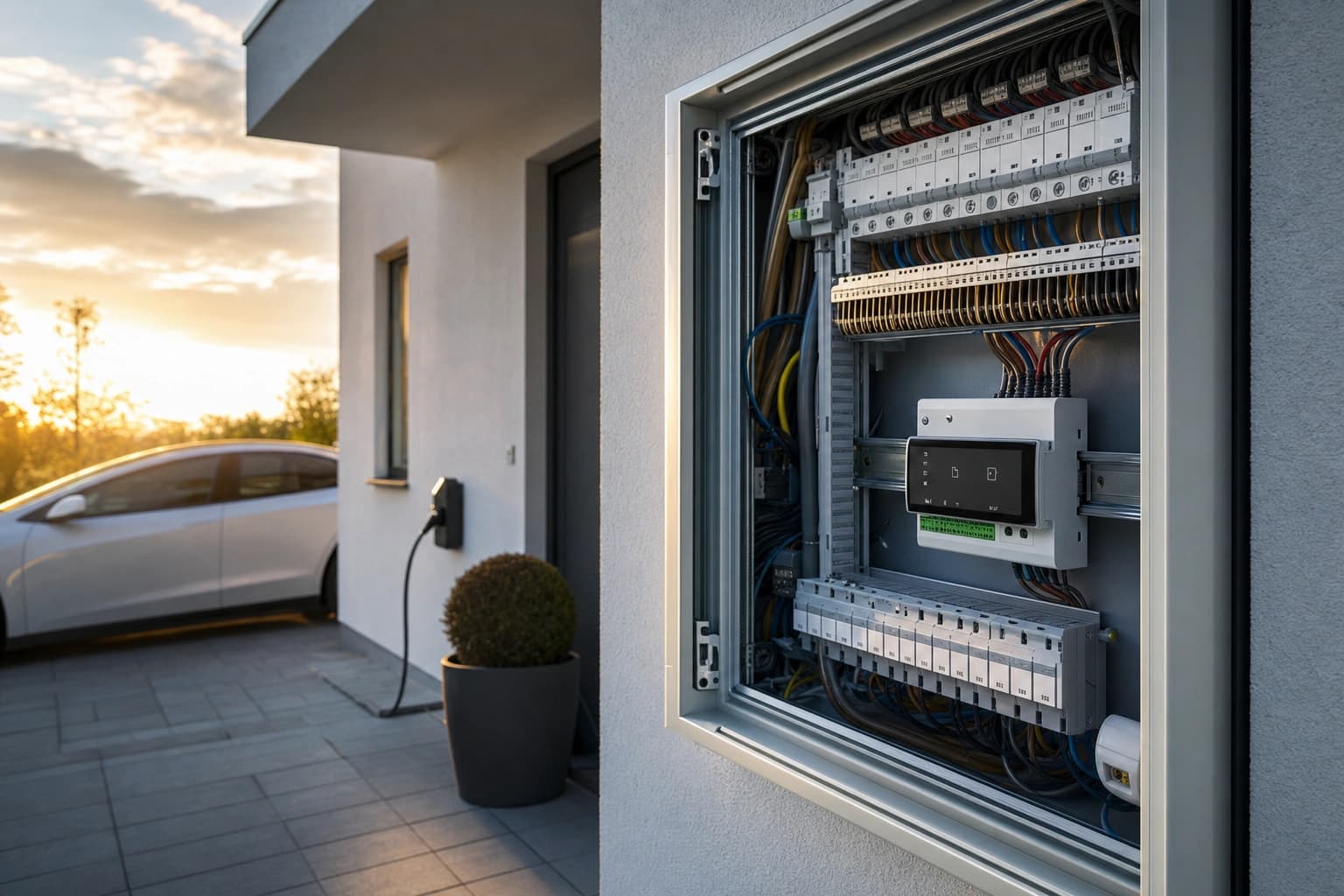
The company's grid connection limits the maximum available power. If several wallboxes charge simultaneously with high power (e.g. 22 kW), the connection is quickly overloaded, leading to failures or high costs for the grid connection (increase in connection capacity). To avoid this, load management (Load Management) is indispensable. It distributes the available power dynamically to the connected vehicles.
Obligation to control (Section 14a EnWG)
Since 1 January 2024, grid operators may briefly throttle controllable consumption units such as wallboxes above 4.2 kW connected load to a guaranteed minimum of 4.2 kW during grid bottlenecks (Section 14a EnWG). In return, grid fees drop, either via an annual flat amount or a percentage reduction. Details on both modules and the exact mechanism are covered in the Section 14a EnWG section further below.
Costs for building commercial charging infrastructure
The costs for charging infrastructure vary greatly depending on power, number of points and structural conditions (e.g. earthworks, underground car park). According to the National Control Centre for Charging Infrastructure, development and operation are currently often still not very profitable, and there are hardly any viable business models without support [NOW]. Nevertheless, the existence of charging infrastructure is decisive for the purchasing decision of consumers and the attractiveness as an employer [NOW].
- Hardware (Wallbox/Charging point): Guideline value 500 to 2,500 euros per charging point (depending on AC/DC and power class).
- Installation (cable routes, earthworks, connection): Guideline value 1,000 to 3,000 euros per point (can be significantly higher for underground car parks or long cable runs).
- Network components & load management: Guideline value 500 to 1,500 euros one-off.
Funding opportunities for commercial charging infrastructure
The Federal Government promotes the expansion of charging infrastructure to prepare the market [NOW]. The National Control Centre for Charging Infrastructure at NOW GmbH coordinates these activities. A current focus is on building a network for ultra-fast charging with the goal of 1,000 new fast charging locations [NOW]. Financing models are used in which lucrative locations are bundled with less lucrative ones to ensure a comprehensive network [NOW].
Specific funding programmes are also relevant for companies (e.g. KfW funding 440 for commercial charging infrastructure). NOW GmbH offers the StandortTOOL as a planning tool with which the expansion requirement up to 2030 can be calculated [NOW]. It is worth checking the tendering guidelines of the federal funding for charging infrastructure, as often parts of the investment costs are reimbursed.
Legal requirements and standards
Technical and legal framework conditions must be observed when installing commercial charging infrastructure. The charging stations must comply with the standard DIN EN 61851-1 [Wikipedia]. In addition, the Federal Government aimed to establish uniform rules for the activation of the charging point and payment to simplify usage [NOW].
Publicly accessible charging points from 11 kW charging power must generally be equipped with a card terminal (Charging Station Ordinance, accessibility).
When does calibration law apply to a charge point?
A charging station becomes subject to calibration as soon as power is sold or billed to others. Whether 11, 22 or 150 kW, power plays no role under the Measurement and Calibration Act.
The Saxon Calibration Office says: "EV charge points, like traditional fuel pumps, are subject to calibration when used in business. Wallboxes for purely private use are exempt."
Important for businesses: the exemption applies only to purely private use. Any billing to staff, guests, customers or company car drivers can trigger calibration duty, even on a small 11 kW box.
What must a certified charge point do?
It must bill in kilowatt-hours. It must show the start, end and duration. And it must allow later checks of the readings.
- Billing in kWh, no flat fee, no parking time (stay duration).
- Start, end and duration of charging are visible.
- Any extra fees are shown separately.
- Readings and data can be checked later.
"Flat-rate billing is not permitted, nor is billing by parking time," the Saxon Calibration Office clarifies.
What calibration law means in daily life
Anyone installing a wallbox for staff, customers or the fleet and not giving power away free should check calibration compliance before start-up. Retrofitting costs more than planning correctly from the start.
How long is a calibration valid?
AC and DC charge points each have an 8-year calibration period.
The Saxon Calibration Office explains: "A meter may be used until 31 December of a calendar year in which its calibration period ends by calculation."
Beware during repairs
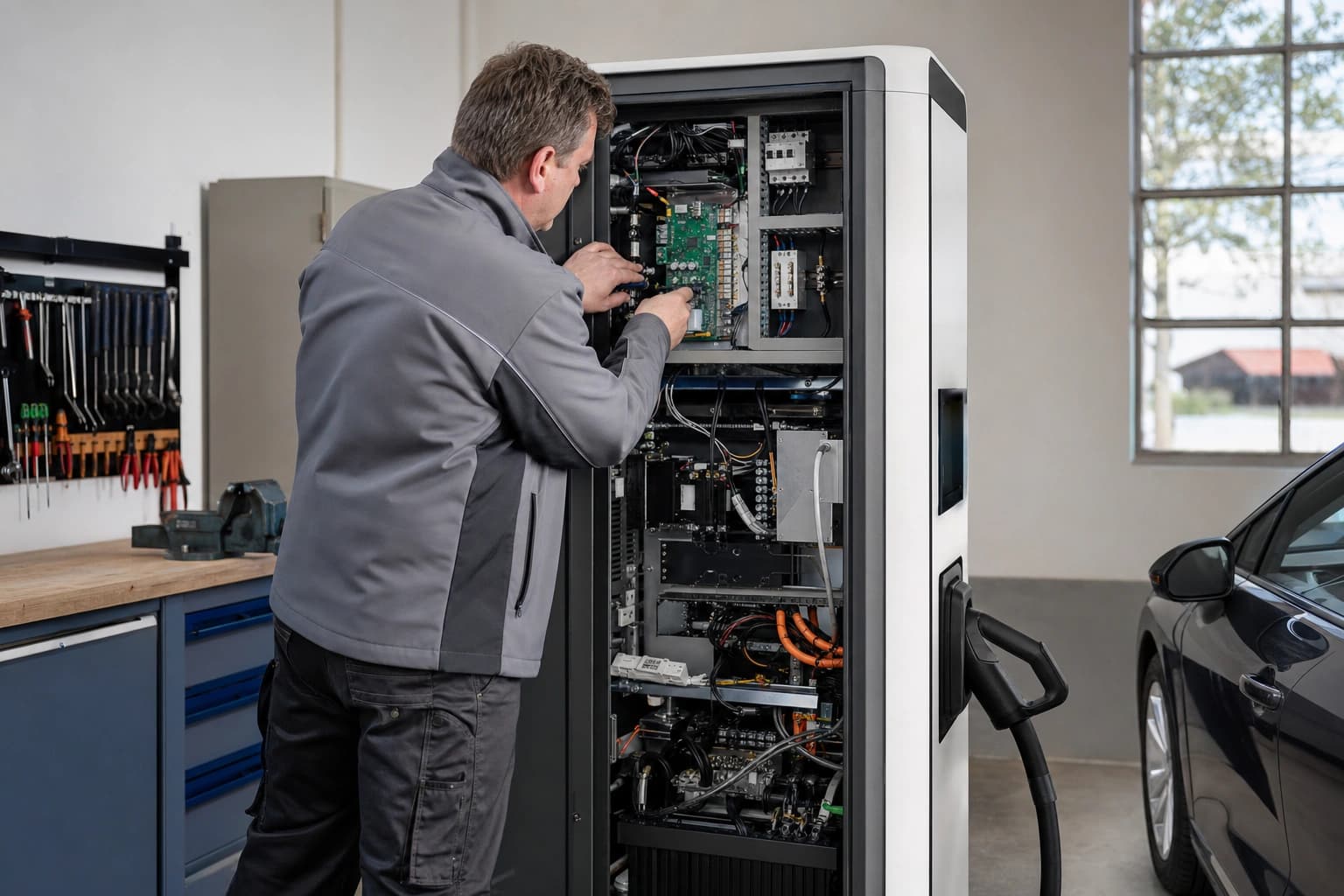
"Tampering or modification of an EV charge point may end the calibration period early," the office warns. Only an authorised repairer (approved specialist firm for repairs) may carry out work. After that, new calibration must be requested without delay.
How do you spot a certified charge point?
By two marks: the permanent conformity mark (manufacturer's calibration mark) on the nameplate and the calibration mark after first calibration.
"Calibration compliance is shown by the correct conformity mark. This conformity mark must be permanently and clearly visible on the charge point (mainly on the nameplate)," says the Saxon Calibration Office. The calibration mark is added during first calibration and shows the end of the current period.
What if an old charge point is not certified?
Retrofit it. And coordinate with the relevant calibration authorities.
"Operators of charge points currently billing through non-compliant metering must retrofit or replace it to meet Measurement Act requirements," the Saxon Calibration Office writes. The authorities then agree individual measures with operators.
Practical tip for DC charge points
For non-compliant DC charge points, the Saxon Calibration Office refers to the recommendations of the National Platform for the Future of Mobility (NPM AG 5) dated 18 January 2019 as a "helpful retrofit approach".
How does § 14a EnWG affect commercial wallboxes?
Since 1 January 2024, grid operators can briefly throttle wallboxes above 4.2 kW connected load (maximum power at the grid connection) to 4.2 kW. In return, grid fees drop. This 4.2 kW figure applies as the standard case for a single, directly controlled wallbox. For connections above 11 kW or several charge points bundled via an energy management system, a different formula applies instead, among others 0.4 times the connected load.
According to Gasag, the rule covers controllable consumer devices under § 14a EnWG 2024: "To avoid grid overload, the grid operator can throttle individual devices such as heat pumps or wallboxes to 4.2 kilowatts (kW)."
- New installations from 01.01.2024 with power above 4.2 kW.
- Existing installations before 01.01.2024 with agreed control.
- Several devices at the same connection whose total power exceeds 4.2 kW.
What grid-fee models does § 14a bring?
The Federal Network Agency has set two modules for 2024. Operators choose exactly one.
Module 1 is a flat annual reduction: "Depending on the grid area (your grid operator's region), the reduction is between €110 and €190 gross per year, equal to 50 to 95 percent off the grid fee," Gasag reports, citing BNetzA decisions.
Module 2 reduces the energy price (usage-based portion of the grid fee) by a flat 60 percent, so businesses pay only 40 percent of the usual energy-price portion. A separate meter for the controllable consumption unit is required, and no base fee applies. Businesses check directly with their grid operator which module suits them best.
Modules cannot be combined
Anyone planning several wallboxes or a whole depot (site with many charge points) should check with the grid operator before registration which module suits best. The two options cannot be combined.
Frequently asked questions
- What charging power and how many charging points do I need for my business?
- For employee car parks, AC charging with 11–22 kW is sufficient. The number of points depends on the fleet size; a guideline value is 20–30% of parking spaces, provided not all vehicles are electrified.
- What does it cost to build a charging infrastructure for companies?
- The costs consist of hardware and installation. Guideline values are 500–2,500 euros for hardware and 1,000–3,000 euros for installation per charging point, depending on construction effort.
- What funding is available for commercial charging infrastructure?
- The federal government promotes expansion, among others, via KfW programmes and federal charging infrastructure funding, coordinated by NOW GmbH. A focus lies on fast charging networks.
- What must be observed regarding the grid connection and load management (Section 14a EnWG)?
- The grid connection limits the total power, load management distributes it dynamically across several charge points. Since 1 January 2024, the grid operator may briefly throttle wallboxes above 4.2 kW to a guaranteed minimum of 4.2 kW during bottlenecks (Section 14a EnWG); in return, grid fees drop either as a flat amount or a percentage.
- AC or DC charging: Which technology fits my application?
- AC (Type 2) is inexpensive and ideal for dwell times > 1 hour (workplace, home). DC (CCS) is expensive but charges quickly (50–150 kW) and is suitable for short stops (logistics, customers).
- Which legal requirements apply (Charging Station Ordinance, Calibration Law)?
- The DIN EN 61851-1 standard applies. Public charging points from 11 kW usually need a card terminal (Charging Station Ordinance). Calibration law applies regardless of charging power as soon as power is sold or billed to third parties; certified charge points must then bill in kWh and observe an 8-year calibration period.